)
Sticking the course: China Two Sessions 2026
- Wealth
- Management
Charles Hamieh, Shane Hurst and Nick Langley
)
ClearBridge Investments believes the outlook for infrastructure in 2026 remains robust, driven by the accelerating demand for power and data fueled by AI.
The explosive rise of artificial intelligence (AI) and data centers is driving unprecedented demand for electricity and gas, leading utilities to invest heavily in smart grids, reliability and efficiency.
Structural tailwinds like decarbonization, network upgrades and climate-proofing are fuelling long-term capital expenditure cycles.
Essential service assets such as utilities are resilient to economic volatility, with earnings stability supported by long-term contracts and regulatory frameworks. Even in uncertain macro environments, infrastructure stands out for its defensive characteristics and steady returns.
Listed infrastructure has seen strong returns in 2025, helped by AI-driven demand for power from electric utilities and gas infrastructure. We sat down with ClearBridge Portfolio Managers Charles Hamieh, Shane Hurst and Nick Langley to discuss how AI growth and other drivers of infrastructure returns — capital expenditure (capex) to replace aging facilities and equipment, resiliency spending, onshoring and global fiscal and monetary policy — are positioning the asset class for 2026 and beyond.
Nick Langley: Infrastructure has been benefiting from structural tailwinds such as decarbonization, investment in aging network infrastructure to improve resiliency, and AI and data center growth, which is driving power demand. These will all be in play in 2026 and beyond, and we don’t think they are being captured by markets, so infrastructure valuations are attractive, especially given the length and transparency in their spending and returns (Exhibit 1). Most of our exposure is in the U.S., where utilities are experiencing unprecedented regulated earnings growth generated by increases in their asset bases because of this enormous capital spending. The outcome is that utilities are trading at the lower end of their EV/EBITDA range over the last decade while generating significantly higher earnings growth. In addition, the fiscal environment is positive, especially in the U.S. and Europe, and global monetary policy is generally neutral to easing. So, we think infrastructure is very attractive for 2026 and our portfolios are well-positioned.
Exhibit 1: Listed Infrastructure Sector Consensus EV/EBITDA
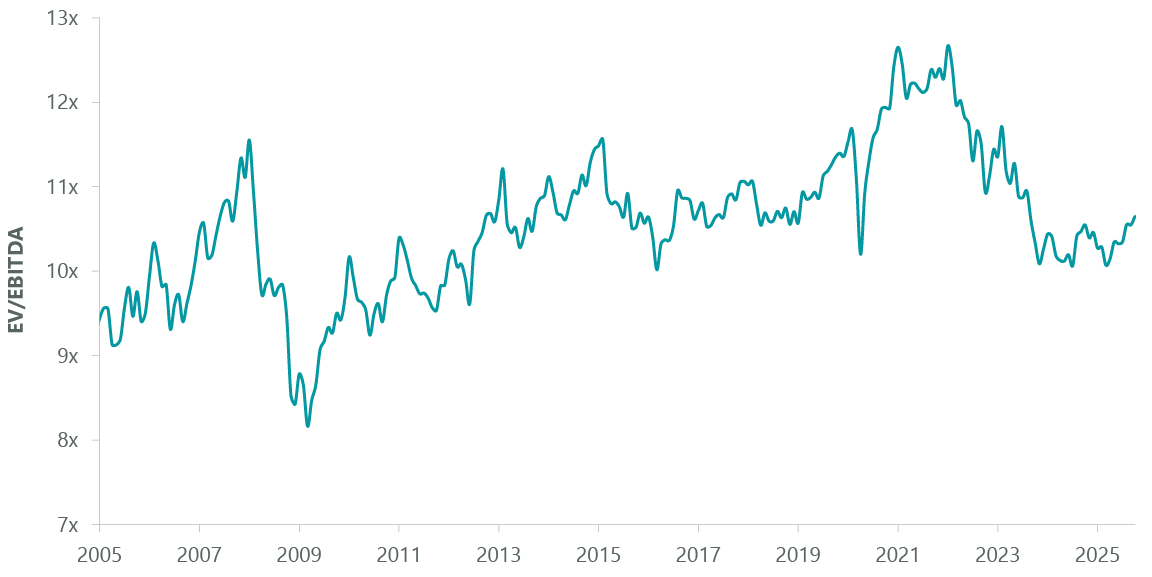 Historical trend using FY1 EBITDA. As of 30 September 2025. Source: ClearBridge Investments, FactSet.
Shane Hurst: The need to power AI and the growth of data and compute it entails has led to explosive power and gas demand. Electric and gas utilities are investing heavily in building smart grids with improved demand response and in reliability and efficiency. Utilities have also greatly benefited: they are deploying large amounts of capex in the development and ongoing operation of data centers. Tech sector capex for new data centers is expected to total US$6.78 trillion by 2030. The base case for global data center power demand growth is 22% compounded annually to 2030, while investment in data center construction should rise to US$49 billion per year by 2030 (Exhibit 2). According to the International Energy Agency (IEA), in the U.S., data centers are on course to account for nearly half of electricity demand growth through 2030 — largely driven by AI usage.
Exhibit 2: Global Data Center Power Demand Leading to Investment
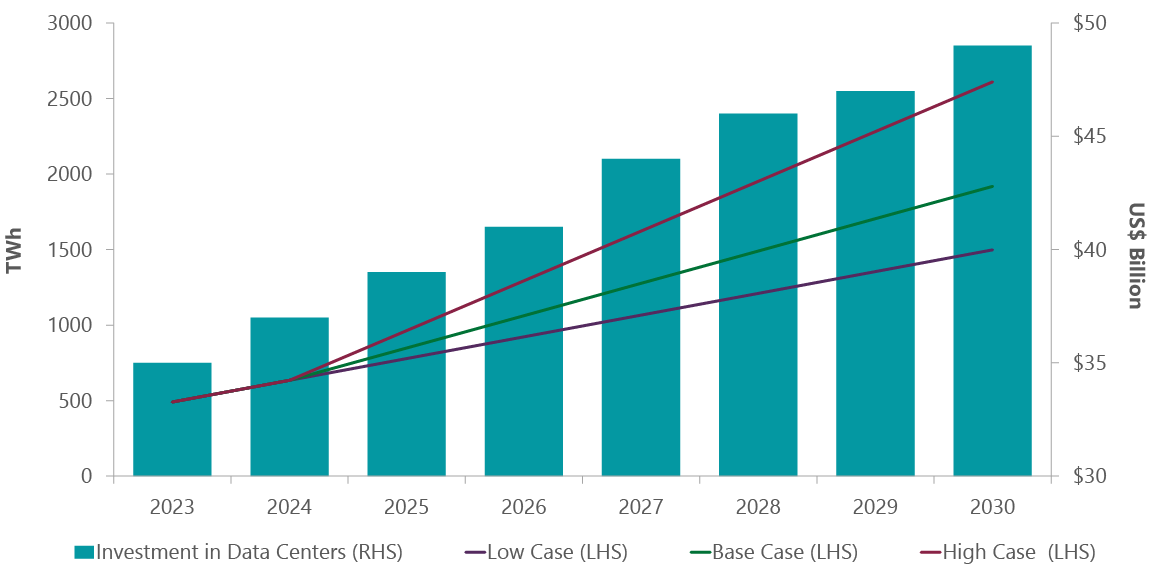 As of 30 September 2025. Source: Internal Research, McKinsey, IEA, Morgan Stanley, WFG, BNEF, EIA. Investment is construction only and does not include equipment.
Charles Hamieh: Hyperscalers have generally struck 15- to 20-year contracts where the utility supplies the infrastructure (including power) and gets an attractive return on its equity, normally in the range of 9%–12%. For existing projects, the utility is 100% protected and will receive a return on its investment. That also means that current guidance upgrades are structural and have transparency out 7–10 years.
Risks we’re monitoring include pressure on residential customer bills through higher power prices, which becomes political and may lead to concern that data center growth is bad for utility customers in general. Also, electricity grid constraints, in the form of delays in interconnection agreements, power plants and approvals. Supply chain and construction delays could mean cost increases, insufficient labour or lack of specialised equipment. There’s a chance, although I believe a small one, that some type of meaningful change in technology might also translate through to significantly more power efficiency and less power demand. Finally, funding constraints on the growth in data centers, while very unlikely, would lead to a slowdown in growth.
Charles Hamieh: Along with gas, nuclear generation is the only base load 24/7 traditional generation currently being built. Nuclear also has the added benefit that it is clean. The downside is the longer lead time on builds, but if the small modular reactors model can be proven, this form of generation will be far more prevalent in the next decade.
Nick Langley: Decarbonization and the clean energy transition continue to drive investment into renewables globally as well as retirement of carbon-based generation such as coal. While certainly some of the hype has come out of the market, most countries and many of the largest companies still have clear decarbonization targets. Much of the spending required to meet these targets is related to poles and wires networks, nearly all of it earning regulated returns. Further climate-proofing and spending on physical asset risk mitigation has been a large feature of capex plans, especially in places like California and the U.S. Gulf Coast. Global utilities are major beneficiaries of these trends.
Resource efficiency and nature-positive infrastructure are also important for our U.K. water companies, as they roll out their next five-year capex plan. Stepping back, the global water infrastructure gap is large. Aging systems, climate change (droughts and floods), and rising demand mean many regions need major upgrades. Governments and regulators are increasingly prioritizing water quality, reliability, resilience and efficiency, as we saw in the recent U.K. regulatory review. This received further positive support through the Cunliffe review, which aims to support water quality, water company performance and efficiency into the future.
Shane Hurst: While over 90% of our portfolios can directly or indirectly pass through inflation, listed markets often react to surprises in inflation data. With inflation in 2025 largely subdued, outside of periods like April where there were concerns tariffs may be inflationary, inflation has had a limited impact. In April, as the market sold down on tariff expectations, listed infrastructure investors were able to use this volatility to position in high-conviction names that were only impacted by beta, not fundamental changes. Investors in unlisted infrastructure could not have taken advantage of this opportunity, given the lack of liquidity and the time it takes to execute a deal.
The large government debt burden has led to a greater reliance on the private sectors for growth initiatives, as government spending focuses on areas such as defence. That has led to improved siting and approvals of projects and more constructive regulation in some regions.
Nick Langley: We are heavily exposed to global electric utility companies, given the trends discussed above. North American gas pipelines are also compelling, with expansions driven by the need to satisfy new gas-fired plants (that stabilise the grid and supply power to data centers) and LNG export needs. High-efficiency gas generation will also help stabilise grids as they decarbonize. Global renewables and energy storage solutions are likewise benefiting from the need for more power (driven by coal-fired generation retirements and data center demand growth) and to decarbonize grids. Finally, user-pays infrastructure in Europe looks attractive where, in many cases, airports and toll roads are hitting capacity. This is creating a greater need for investment to expand capacity and generating attractive returns.
The outlook for infrastructure in 2026 remains robust, driven by the accelerating demand for power and data fuelled by AI, as well as decarbonization and network investment to replace aging infrastructure, improve resiliency and support onshoring and supply chain realignment. Utilities and GDP-sensitive infrastructure assets such as airports and toll roads are positioned to benefit from long-term contracts, regulatory support and essential service status, which provide earnings stability even in volatile macro environments. While risks such as grid constraints, political pressures related to affordability and supply chain challenges persist, opportunities abound in developed markets, especially in North America and Europe. Ultimately, we believe infrastructure stands out as a resilient asset class, offering attractive returns and defensive qualities amid shifting economic conditions and rapid technological advancements.
Source: Franklin Templeton
Endnotes
Source: McKInsey & Company, “The cost of compute: A $7 trillion race to scale data centers”, April 28, 2025.
Source: GOV.UK, Independent Water Commission, July 2025. The Cunliffe Review is a major report Sir Jon Cunliffe, calling for a "total reset" of the UK water sector with 88 recommendations to fix fragmentation, poor regulation, and environmental failures.
Definitions
Twh most commonly stands for Terawatt-hour, a large unit of electrical energy (one trillion watt-hours) used for measuring power consumption and generation.
The EV/EBITDA multiple is a valuation metric used to compare the value of different companies. It measures a company's enterprise value (EV) relative to its earnings before interest, taxes, depreciation, and amortization (EBITDA). A lower ratio generally suggests a company might be undervalued compared to its peers with higher multiples.
Hyperscalers are companies that own and operate massive data centers to provide highly scalable cloud computing services like Infrastructure as a Service (IaaS) and Platform as a Service (PaaS).
Capital expenditure (capex) and refers to investment spending in long-term assets (fixed assets). These expenditures include new buildings, machinery, and other equipment needed for an organization's day-to-day operations. Most companies use capex financing to fund their long-term investments.
What are the risks?
All investments involve risks, including possible loss of principal. Please note that an investor cannot invest directly in an index. Unmanaged index returns do not reflect any fees, expenses or sales charges. Past performance is no guarantee of future results.
Equity securities are subject to price fluctuation and possible loss of principal.
International investments are subject to special risks including currency fluctuations, social, economic and political uncertainties, which could increase volatility. These risks are magnified in emerging markets.
Commodities and currencies contain heightened risk that include market, political, regulatory, and natural conditions and may not be suitable for all investors.
Diversification does not guarantee a profit or protect against a loss. Dividends may fluctuate and are not guaranteed, and a company may reduce or eliminate its dividend at any time.
Companies in the infrastructure industry may be subject to a variety of factors, including high interest costs, high degrees of leverage, effects of economic slowdowns, increased competition, and impact resulting from government and regulatory policies and practices.
Investment strategies which incorporate the identification of thematic investment opportunities, and their performance, may be negatively impacted if the investment manager does not correctly identify such opportunities or if the theme develops in an unexpected manner. Focusing investments in information technology (IT) and technology-related industries carries much greater risks of adverse developments and price movements in such industries than a strategy that invests in a wider variety of industries.
Franklin Templeton Australia Limited (ABN 76 004 835 849 / AFSL 240 827) is the product issuer. Franklin Templeton Australia Limited have not taken your or your clients’ circumstances into account when preparing this content so it may not be applicable to the particular situation you are considering. You should consider your or your clients’ circumstances and the relevant Product Disclosure Statements (PDSs) or Prospectuses before making any investment decision. You can access Franklin Templeton Australia Limited’s PDSs or Prospectus online or by calling them. This material was prepared in good faith and neither Franklin Templeton Australia Limited nor Specialised Private Capital accept any liability for any errors or omissions. Past performance is not an indication of future performance.
)
)
)
)

Our boutique size enables Specialised Private Capital to forge relationships with well regarded investment firms.
Contact UsKeep up with the latest news and insights at Specialised Private Capital Ltd