)
- Insights
Market Trends August 2026
David Bassanese
)
- AI
Key global developments in July
The end of the US-Iran peace deal led to a renewed surge in oil prices and bond yields, yet equities held up due to continued solid growth in earnings. Higher oil prices and bond yields helped the energy and financial sectors especially.
A lower-than-expected June US CPI result helped the Fed remain on hold in July, though bond markets remain unsure about the Fed’s resolve to bring down inflation.
Increased Chinese competition and an unwinding of speculative excess in South Korea led to a rout in global technology stocks, especially in Asia.
A lower-than-expected Q2 Australian CPI result – along with falling house prices –eased fears the Reserve Bank will raise rates this month. Australian stocks outperformed global peers, helped by a lower exposure to technology stocks and higher exposure to financial stocks.
Interest rates
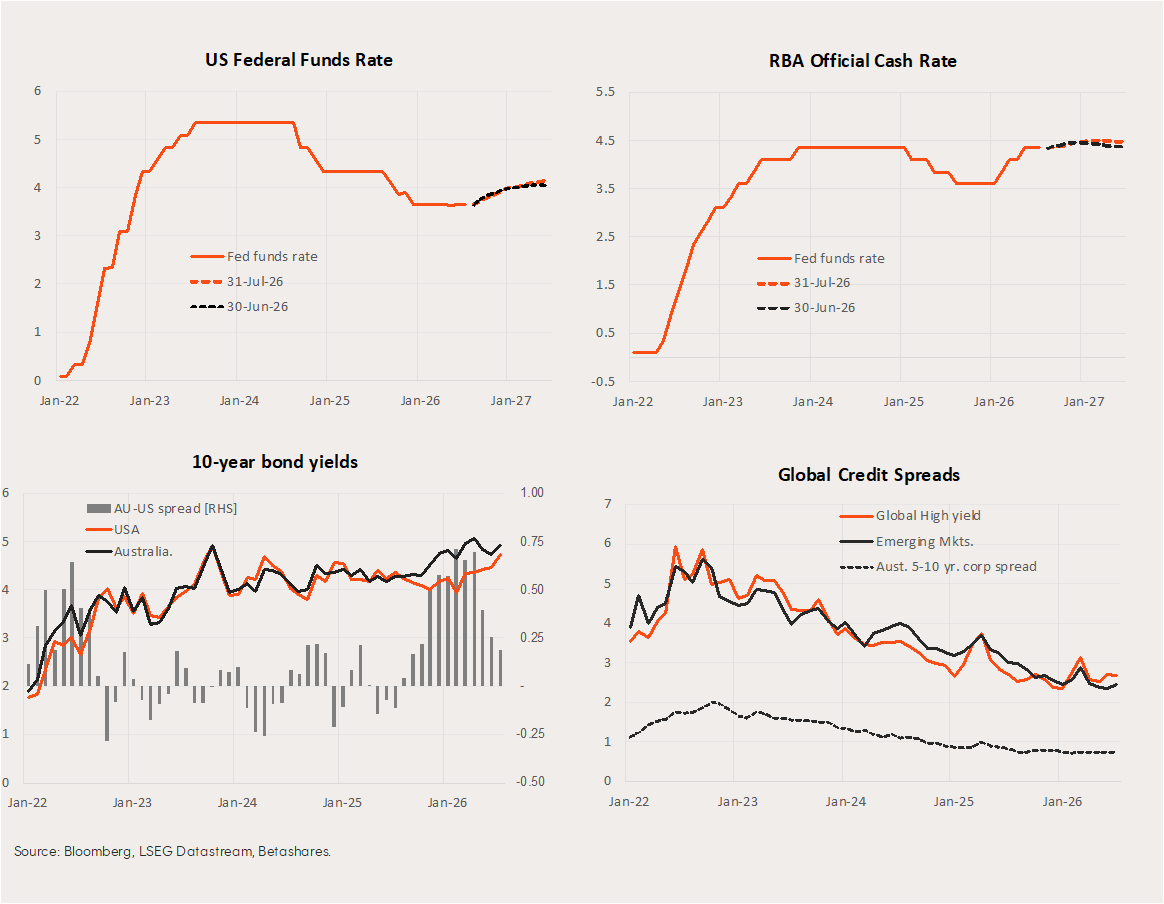
The rebound in oil prices led to a modest increase in expected policy rate increase in 2027, though nearer-term policy expectations remained largely unchanged. Markets are pricing 0.3% of policy tightening by end-2026 in the US, and 0.12% in Australia.
US 10-year bond yields rose by 0.27% to 4.74%, whereas Australian 10-year yields eased by 0.20% to 4.93%, resulting in a further narrowing in the Australian-US 10-year bond yield differential to 0.19%. Bond yields in both markets have trended modestly higher since late 2025, due to a shift from rate cut to rate hike expectations. Assuming the worst is priced in terms of rate hike expectations, bond yields are likely to move sideways to down in coming months.
Emerging market bond spreads ticked up in July, while high yield and local corporate spreads remained contained. Ongoing resilient global economic growth bodes well for continued tight credit spreads.
Commodity prices
A strong rebound in oil and LNG prices led the benchmark index of global commodity prices* to rise 6.1% in July after a 7.5% decline in June.
Despite higher bond yields, gold prices held up in July with a 1% gain, perhaps helped by a small decline in the $US. Iron-ore prices also eased on global growth concerns, though industrial metals and agricultural prices firmed. Assuming a peace deal is eventually reached in Iran, commodity prices may ease back in coming months.
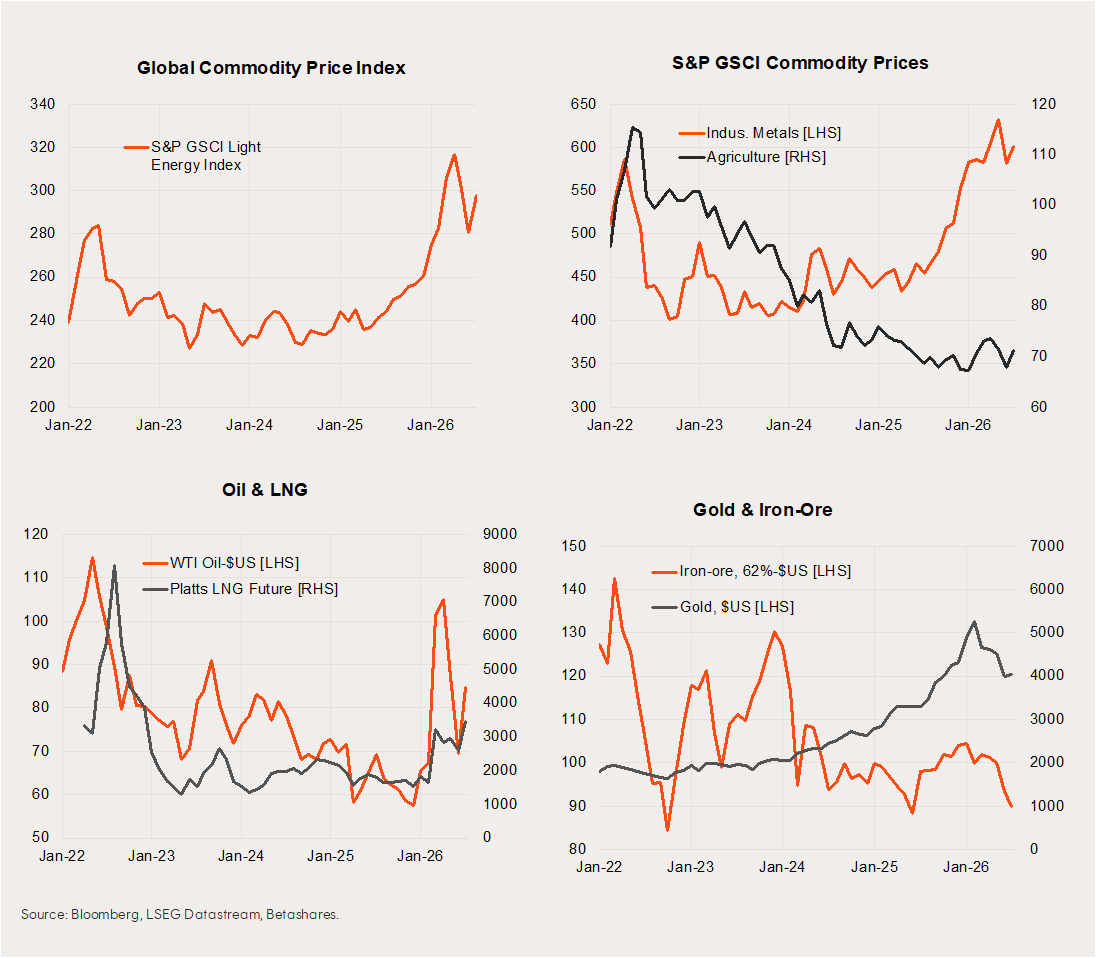 *Defined as the S&P GSCI Light Energy Index, which includes a range of prices covering energy, metals, agriculture and livestock.
Exchange rates
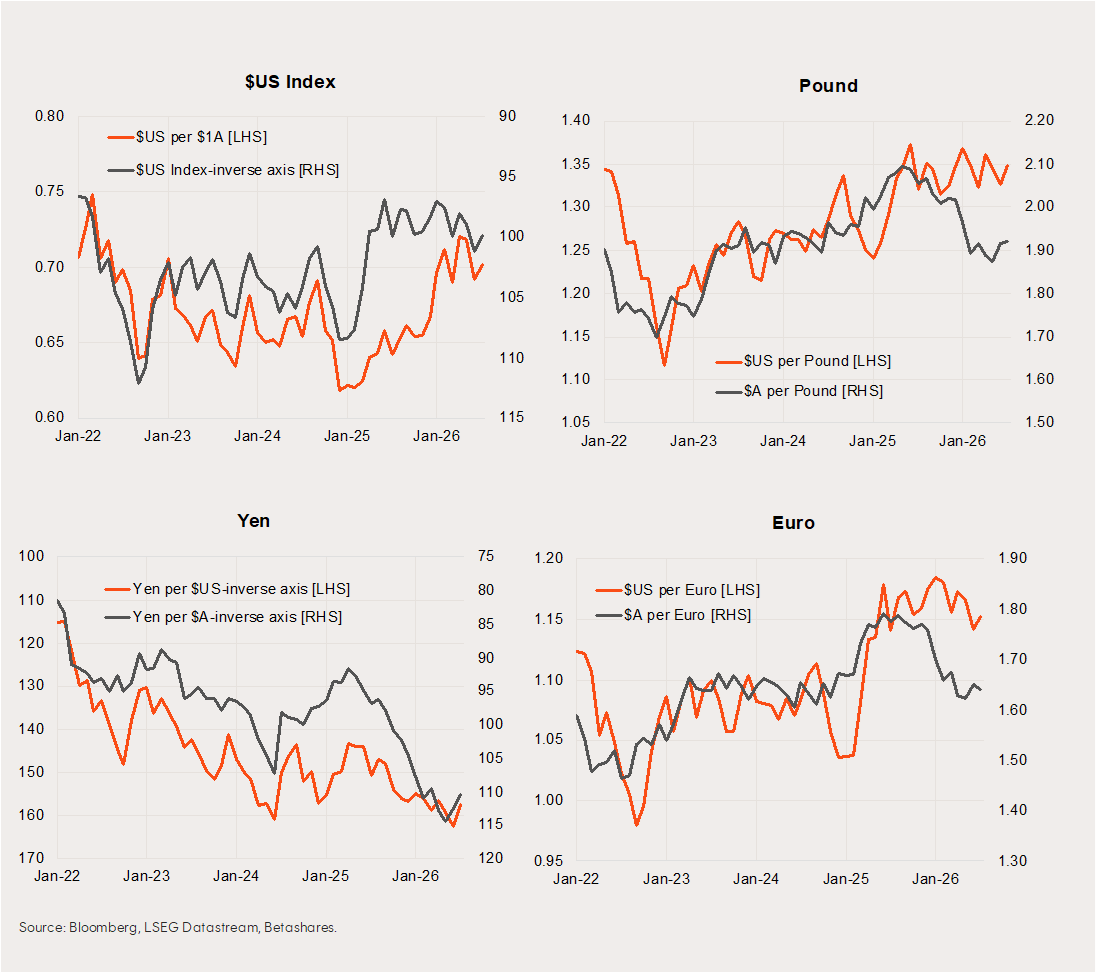
The $US index eased back 1.3% in July, likely reflecting relief the Fed did not raise interest rates in the month together with a rebound in the beleaguered Japanese Yen due to month-end joint US-Japanese currency intervention. The $A firmed 1.5% against the $US to US70.2c.
A shift in the relative US-Australian interest rate outlook has checked the $A’s strength in recent months, though upward pressure on the $US could wane if the Fed – as I still expect – resists pressure to raise interest rates this year.
Global equities
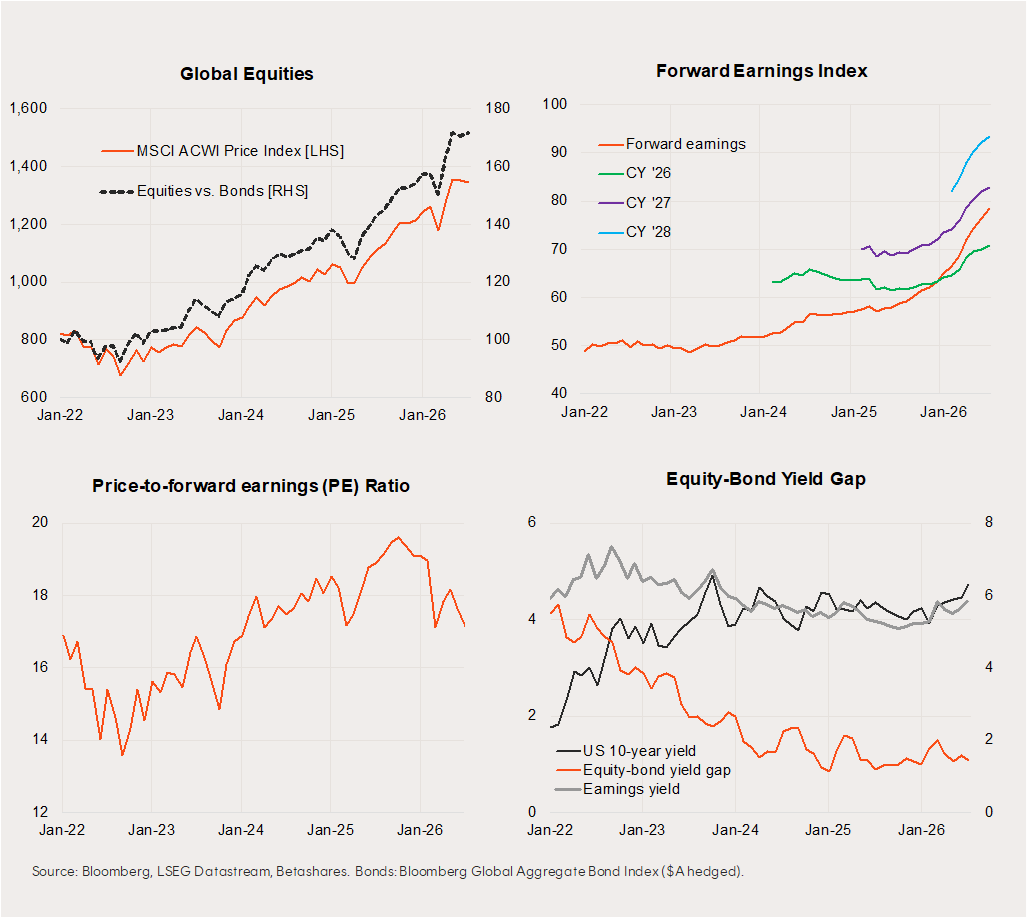
Global equity returns dipped a further 0.3% in July in local currency terms, and by 1.3% in unhedged $A terms due to strength in the $A.
The flat global equity performance again reflected a pull-back in valuations, offset by a further lift in forward earnings. At 17.2, the global forward PE ratio is now down 12.2% from its recent end-month peak of 19.6 in October last year. More than offsetting this, forward earnings are up 27.5% over the same period.
Global earnings expectations remain upbeat, with 5.6% expected further growth in forward earnings by year-end and 19.1% by end-2027. PE valuations are at the lower end of their range over the past three years. Assuming relatively stable bond yields and continued strength in corporate earnings, the global equity outlook remains encouraging.
Australian equities
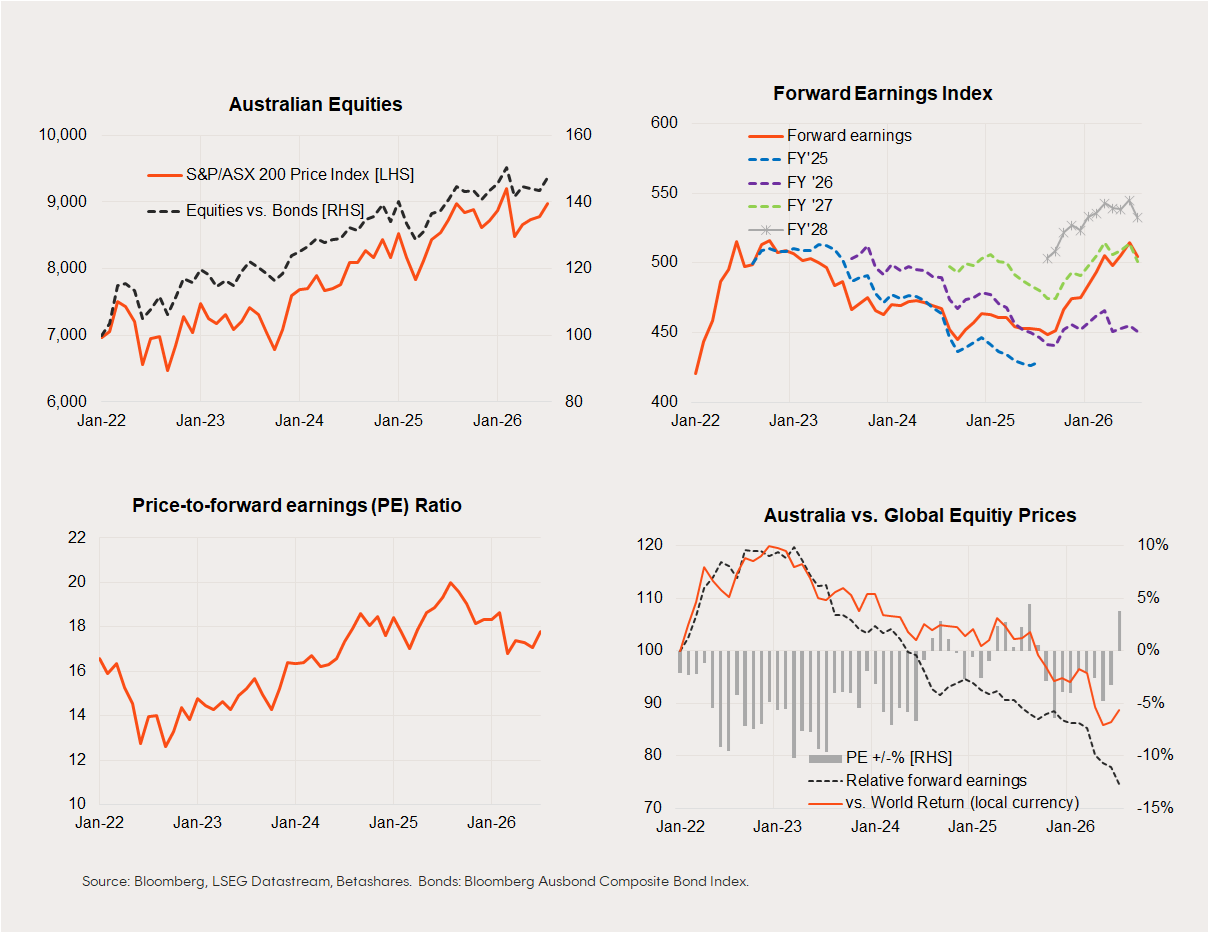
Australian equities lifted further in July, with the S&P/ASX 200 returning 2.3% following a 0.7% gain in June. Energy and financials were the standout sectors.
Opposite to that of global markets, however, the gain reflected a lift in valuations offset by a decline in forward earnings. Earnings expectations also declined in the month, largely reflecting downgrades in energy and materials.
That said, current earnings expectations are consistent with only 2.5% growth in forward earnings by year-end, and 5.6% by mid-2027 – weaker than that of global markets.
At 17.8, the forward PE ratio ended July trading at a modest 4% premium to global markets and down from its recent peak of 20 in August last year. Australia’s weaker earnings outlook and likely subdued economic growth suggest a continued trend of equity underperformance versus global peers – though one potential offset would be if global technology stocks continued to sell off on AI bubble fears.
Equity themes/trends
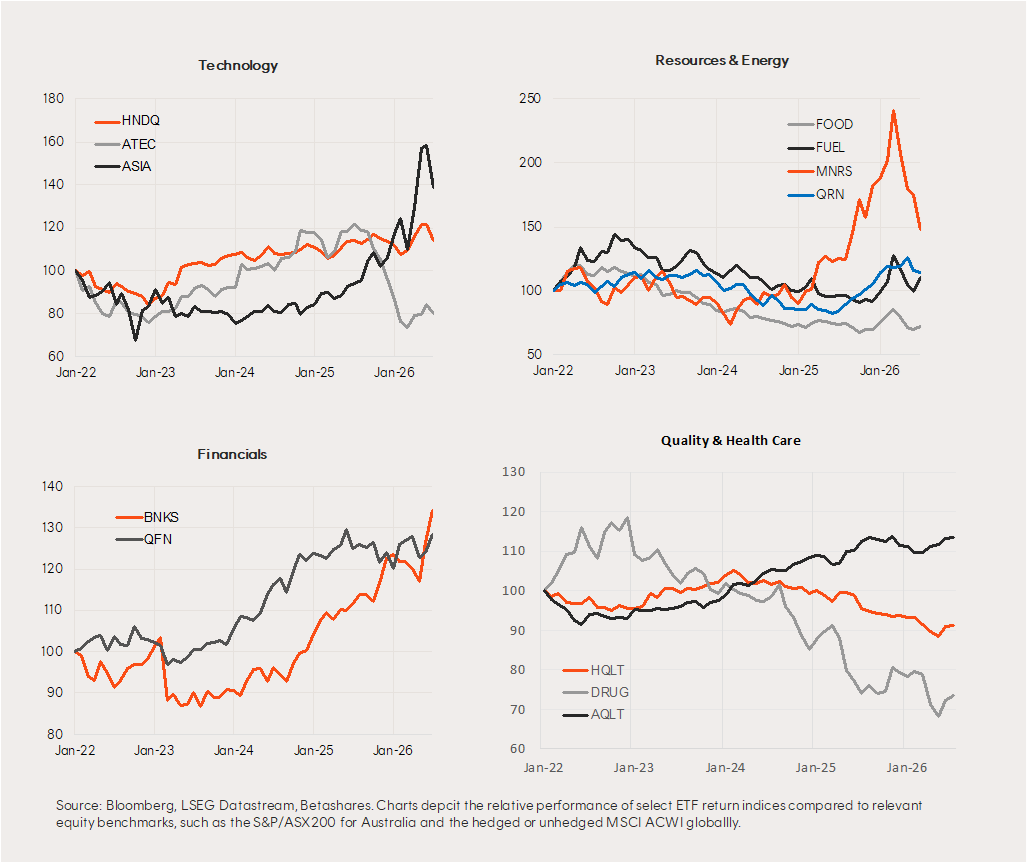
The high-flying Asian technology sector (ASIA ETF) fell back to earth in July, with global gold miners (MNRS ETF) also continuing to unwind the previous trend of strong outperformance. Global energy (FUEL ETF) performance rebounded as would be expected, though more broadly financials, health care and quality appear to be benefitting most from the global technology shake out.
Should an enduring peace deal in Iran be struck, this may support further weakness in commodity-related themes. The fate of technology exposures continues to wax and wane, though my expectation is that optimism in the AI trade will ultimately hold up for a good while longer.
Published with permission - Betashares Capital Limited.
Source: Betashares
The information contained in this publication is general information only and does not take into account any person’s financial objectives, situation or needs. Investors should consider the appropriateness of the information taking into account such factors and seek financial advice. This publication is provided for information purposes only and is not a recommendation to make any investment or adopt any investment strategy. It has been prepared by Betashares Capital Limited (ABN 78 139 566 868 AFSL 341181) (Betashares). Future outcomes are inherently uncertain. Actual outcomes may differ materially from those contemplated in any opinions, estimates or other forward-looking statements given. To the extent permitted by law Betashares accepts no liability for any errors or omissions in, or loss from reliance on this information.
In partnership with
)
Discover more insights
)
)

Call to Action
Our boutique size enables Specialised Private Capital to forge relationships with well regarded investment firms.
Contact UsSubscribe
Keep up with the latest news and insights at Specialised Private Capital Ltd